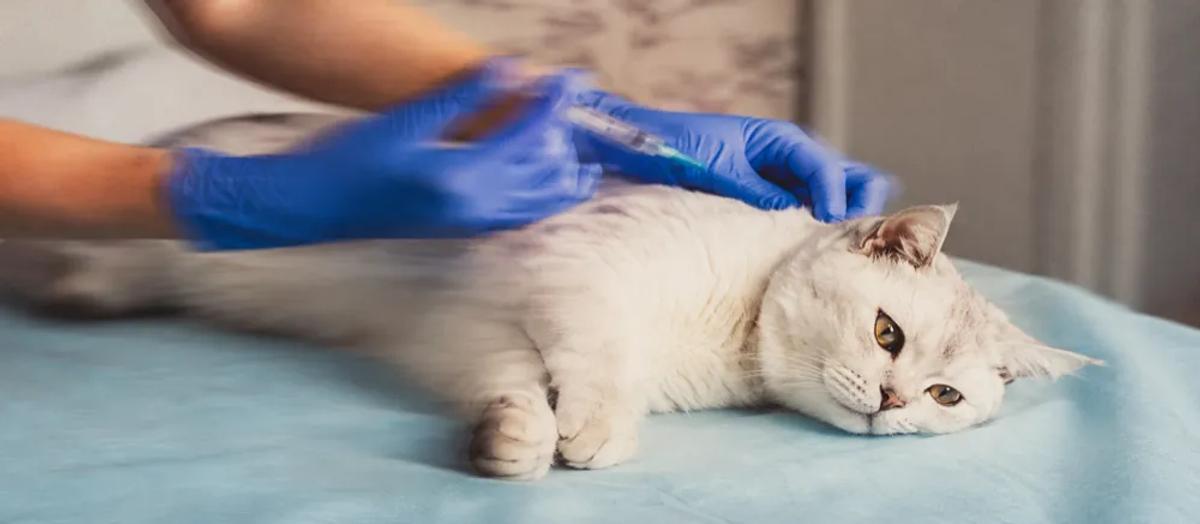
Your cat's first rabies shot is given from three months of age, and after that it is repeated on the interval the product leaflet sets, which in an endemic country like India means a yearly booster. In India the vaccine counts as core for cats, because rabies is endemic here and virtually always fatal once symptoms appear. What surprises most people is the legal side: there is no clear national law that specifically requires you to vaccinate your pet cat.
Rabies gets one section in the main cat vaccination guide. Here it gets the whole page, schedule and legal position included.
Why rabies matters for a cat, even an indoor one
The World Health Organization's position is that once clinical symptoms appear, rabies is virtually 100% fatal, and that clinical rabies in people can be managed but very rarely cured, and not without severe neurological damage. It spreads through saliva, usually by a bite or a scratch, which makes it a matter of public health well beyond your own pet. India carries a heavy share of the global burden, and the national rabies guidelines record that dogs are responsible for about 97% of human rabies here, with cats accounting for about 2%. That distribution explains why almost every Indian rabies rule you will find is written about dogs, and it is why the legal question for cats has the answer it does.
Cats are a smaller part of that picture, but they are not outside it. A cat that slips out an open door, or lives in a building full of community animals, can be exposed just the same. That is the reasoning behind treating rabies as a core vaccine for cats in an endemic country, indoor or not.
The schedule
WSAVA's feline table sets no age and no interval for rabies. Its instruction is to follow local regulations as a priority and, where there are none, to follow the product leaflet. No national Indian rule sets a rabies schedule for pet cats, so unless your municipality has a bye-law of its own, the leaflet is what governs. The Nobivac Rabies leaflet for the Indian market, which puts dogs and cats on the same line, reads:
- First rabies shot from three months of age.
- If it is given earlier than that, the leaflet asks for a repeat dose at three or six months of age depending on the species, and cats sit on the three-month line with dogs.
- Revaccination every three years, with the leaflet's own footnote against that figure recommending annual revaccination in endemic areas.
That last line is where the confusion sits. The three-year figure is what the revaccination column says; the footnote attached to it recommends annual revaccination in endemic areas, and India is endemic, so a year is the interval that applies here. Ask your vet which product your cat is getting and what interval its leaflet sets.
What the law actually says for cats
Here is where careful reading pays off. It is easy to find pet pages stating flatly that rabies vaccination is legally compulsory for all cats in India. Go looking for the instrument behind that claim and it is very hard to find for cats.
India's national rabies effort is the National Action Plan for Dog Mediated Rabies Elimination, and the name tells you where it is aimed. The other instrument people point to is the Animal Birth Control Rules, 2023, notified as G.S.R. 193(E) on 10 March 2023. Those Rules do put deworming, immunisation and sterilisation of a pet animal on its owner, which sounds like it settles the question. Read the classification clause first. For the purposes of those Rules, "pet animals" means dogs owned and kept indoor by individuals. A cat sits outside that definition, so the owner duty written into the Rules never reaches a pet cat.
Cats are not absent from those Rules, which is the part most summaries skip. Rule 19 is headed "Sterilisation and Immunisation of Domestic or Feral cats". What it provides is narrower than that heading. On the advice of the State Board, a recognised animal welfare organisation with training and expertise in spay or neuter may sterilise cats, in the manner set out in Guidelines for Cat Sterilisation and Immunisation published by the Animal Welfare Board of India, with the infrastructure and costs coming from the local authority. Two things follow. The rule is addressed to welfare organisations and to the municipality that funds them, never to a cat's owner. And those Guidelines are not on the Board's published list of guidelines, which leaves the immunisation named in the heading with no procedure attached to it. So the honest reading is not that India forgot cats. It is that the one rule naming them creates work for institutions and no duty for you.
Worth knowing that the Indian state does treat cat rabies as a public-health matter, just not through a duty on you. The Central Government is implementing a scheme for birth control and immunization of stray dogs and stray cats whose stated objective is to control the stray population by sterilisation and to reduce zoonotic disease by immunisation, and anti-rabies vaccination sits inside the funded package for stray cats, with the money reaching SPCAs and local bodies through the Animal Welfare Board of India and the State Animal Welfare Boards. So the gap is not that India ignores cat rabies. It is that the rulebook aims at community animals and leaves owned cats to their people.
Municipal bye-laws are the layer that can change the answer where you live, and two are worth naming because they are unusually specific about cats. Aizawl Municipal Corporation's Pet (Dog and Cat) Regulations, made under section 371 of the Mizoram Municipalities Act, 2007, bar anyone from keeping a dog or cat over three months of age without registering it, and require the owner to vaccinate that animal against rabies and produce proof of vaccination at the time of registration. Annual re-vaccination is looser than it first looks. The operative regulation says the rabies shot may be got done annually; the note printed on the registration certificate says the owner must. Mohali's bye-laws, notified under the city's official name of Sahibzada Ajit Singh Nagar, define a registrable animal as a he or she cat or dog, ask for registration on or before the 30th of April each year, and make regular health check-ups and vaccination the owner's responsibility, with a two hundred rupee penalty for not producing the certificate when an inspecting officer asks. That last one never uses the word rabies inside the vaccination duty at all; it appears once in the whole instrument, in the clause about reporting a bite.
Whether your own city has a bye-law of this kind is something only your municipality can tell you. None of it makes the vaccine optional. Rabies is endemic here and virtually always fatal once symptoms appear, and veterinary guidance treats the shot as essential for cats even when no law names them. Get your cat vaccinated because the disease is real and deadly here. The absence of a specific law does not change that.
The free and low-cost route
Cost keeps some cats unvaccinated, and the government route is worth asking about. Ask your municipal veterinary department whether it runs anti-rabies vaccination drives and when the next one falls, and call your nearest state veterinary hospital or veterinary-college clinic to ask what it charges. The AWBI stray-cat scheme above is aimed at community animals rather than pets, but it is a sign the local machinery for anti-rabies vaccination exists near you.
Frequently asked questions
Is rabies vaccination compulsory for cats in India?
There is no national law that makes it compulsory for pet cats specifically. The country's rabies law and programme are built around dogs. Municipal bye-laws can go further: Aizawl asks for proof of rabies vaccination when a cat is registered, and Mohali treats a cat as a registrable animal with vaccination as the owner's responsibility. WSAVA's guidelines class rabies as core for cats in areas where the disease is endemic, and India qualifies, so the clinical case for the shot stands whatever the law says.
How often does a cat need the rabies vaccine?
First shot from three months of age, then revaccination on the interval the product leaflet sets. The Nobivac Rabies leaflet for India puts that at three years, with a footnote recommending annual revaccination in endemic areas. India is endemic, so a year is the interval that footnote points to.
Does an indoor cat need a rabies shot?
It is still recommended. An indoor cat can still get out, or run into a stray on a balcony or stairwell, and in an endemic country the consequences of rabies are absolute. The guidelines put rabies in the core group for areas where the disease is endemic, and they draw no line there between indoor and outdoor cats.
Can my cat get rabies from another animal?
Rabies passes through the bite or scratch of an infected animal, so a fight with an infected stray is the realistic route. Dogs are the main source in India, though any unvaccinated animal that goes outside is a possible link in the chain.
The bottom line
Get your cat's first rabies shot from three months of age, then keep it current on the interval its leaflet sets, which in a country where rabies is endemic works out to once a year. Do it because the disease is virtually always fatal once symptoms appear, and know that the national law is written around dogs, which leaves this decision with you. For the full schedule across all the cat vaccines, see the main cat vaccination guide, and for how the shots are grouped, the core versus non-core guide.
If a boarding facility or society asks for proof, a PetID record holds your cat's rabies history behind a QR code that any partner facility can scan. When the request arrives as a written notice, the guide to responding to a society pet notice covers how to answer it.
Sources
- WSAVA Guidelines for the Vaccination of Dogs and Cats (2024). Squires RA, Crawford C, Marcondes M, Whitley N. Journal of Small Animal Practice 2024;65:277-316, doi 10.1111/jsap.13718 (rabies vaccine is core for cats in areas where the disease is endemic; the feline table gives no age and no revaccination interval, instructing instead to follow local regulations as a priority and, where there are none, the product leaflet).
- Nobivac Rabies. MSD Animal Health India (dog and cat, age at primary vaccination after 3 months of age, revaccination 3 years; first footnote: primary vaccination can be administered at an earlier age, but then a repeat vaccination must be given at the age of 3 or 6 months depending on the species; second footnote: annual revaccination is recommended in endemic areas).
- Rabies fact sheet. World Health Organization (rabies infects mammals including cats; it spreads to people and animals via saliva, usually through bites, scratches, or direct contact with mucosa; once clinical symptoms appear, rabies is virtually 100% fatal; clinical rabies in people can be managed but very rarely cured, and not without severe neurological deficits).
- National Guidelines on Rabies Prophylaxis, 2015. National Centre for Disease Control, Directorate General of Health Services, Ministry of Health and Family Welfare, Government of India (section 1, Introduction: in India, dogs are responsible for about 97% of human rabies, followed by cats (2%), jackals, mongoose and others (1%); the disease is mainly transmitted by the bite of a rabid dog).
- Adopt One Health, Stop Rabies: India launches new national action plan for dog mediated rabies elimination by 2030. World Health Organization (India is endemic for rabies and suffers approximately 36% of the world's human rabies deaths transmitted by dogs).
- Animal Birth Control Rules, 2023 (G.S.R. 193(E), 10 March 2023). Ministry of Fisheries, Animal Husbandry and Dairying (Department of Animal Husbandry and Dairying), Government of India, notified by the Central Government under section 38 of the Prevention of Cruelty to Animals Act, 1960 (Rule 7 classifies "pet animals" for the purposes of these Rules as dogs owned and kept indoor by individuals; Rule 8(1) places deworming, immunisation and sterilisation of pet animals on the owner; Rule 8(2) places the same duties for street animals on the local authority; Rule 19, headed "Sterilisation and Immunisation of Domestic or Feral cats", provides that on the advice of the State Board the sterilisation of cats may be conducted by a recognised Animal Welfare Organisation with training and expertise in spay or neuter, in the manner provided in the Guidelines for Cat Sterilisation and Immunisation published by the Board, with infrastructure and reimbursement provided by the local authority).
- Guidelines published by the Animal Welfare Board of India. Animal Welfare Board of India (the Board's own list of published guidelines; it carries no Guidelines for Cat Sterilisation and Immunisation of the kind Rule 19 of the ABC Rules, 2023 refers to).
- Aizawl Municipal Corporation Pet (Dog and Cat) Regulations. Aizawl Municipal Corporation, under section 371 of the Mizoram Municipalities Act, 2007 (Regulation 3(a) bars keeping a dog or cat over three months of age without registering it; Regulation 3(b) requires owners to vaccinate their dog or cat against rabies and to provide proof of vaccination at the time of registration; Regulation 5(b) provides that the rabies vaccination may be got done annually; the Form 2 registration certificate carries a note that the owner must vaccinate annually).
- Municipal Corporation, Sahibzada Ajit Singh Nagar (Registration, Control of Stray Animals and Compensation to the Victim of Animal Attack) Bye Laws, 2020. Municipal Corporation, Sahibzada Ajit Singh Nagar (Mohali), under section 399(E)(6) of the Punjab Municipal Corporation Act, 1976 (definition (h) reads "Registrable Animal" means a he/she cat or dog; clause 3(a) requires registration on or before the 30th day of April each year; clause 7(c) makes regular health check-ups and vaccination at prescribed time periods the owner's responsibility, with a penalty of Rs. 200 for failing to produce the vaccination certificate on demand; the word "rabies" appears in the bye-laws only at clause 7(e)(iii), on reporting a bite).
- Scheme for Birth Control and Immunization of stray Dogs and stray cats. Animal Welfare Board of India (the Central Government implements this scheme and the funds reach SPCAs and local bodies through the Board and the State Animal Welfare Boards; the scheme's stated objective is to control the stray population by sterilisation and to reduce zoonotic disease by immunisation; anti-rabies vaccination is inside the funded package for stray cats).