Take it off the moment you find it. The Companion Animal Parasite Council (CAPC) sets the method: fine forceps, gloved hands, grasp the tick as close to the skin as possible, then extract it with slow, steady, rearward pressure, avoiding crushing, twisting, or jerking. There is no safe waiting period. Three to six hours of attachment is enough for Ehrlichia or Rickettsia to pass from tick to dog, and that is a minimum rather than a countdown.
Where to look, in order
In the 2011 survey of 525 street and shelter dogs, ticks were on 80 percent of those sampled in Mumbai and 75.3 percent in Delhi, so in those cities a walk is not a low-exposure event and a check after one is worth the two minutes.
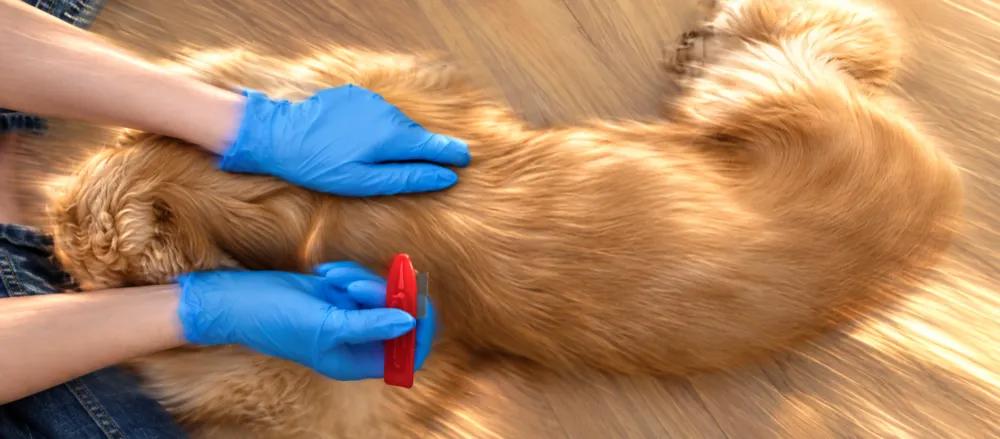
The Tropical Council for Companion Animal Parasites (TroCCAP) names the attachment sites worth checking: ears, armpits, the groin, around the eyes, and between the toes. Those spots are thin-skinned, warm, and out of your line of sight.
Work in that order and use your fingers rather than your eyes. Ticks feel like a small firm bump. TroCCAP notes that one or a few ticks, small larvae especially, can go completely unnoticed on a dog.
There are two shapes to expect. A feeding female swells, because a female hard tick can grow up to 100 times her original weight before dropping off. A male stays flat even after feeding, since his shield covers the whole back and doesn't allow the expansion. People find the swollen ones and miss the flat ones.
How to remove the tick, step by step
CAPC's method comes down to six steps, and the reasoning behind them follows.
- Check the attachment sites listed above and find every tick before you start.
- Put gloves on.
- Grip the tick with fine forceps, as close to the skin as you can get.
- Extract it with slow, steady, rearward pressure.
- Save it, labelled with the date, in case it is needed later.
- Watch the bite site over the following days.
Wear gloves. CAPC's stated purpose is to prevent zoonotic infection if a tick is accidentally crushed during removal, and its guidance for a small number of ticks is that they can be removed manually with forceps and gloved hands.
The forceps matter. CAPC specifies fine forceps rather than fingers, and the grip goes as close to the skin as you can get it.
Do not crush, twist, or jerk. CAPC gives two consequences for doing so: greater exposure of the dog to pathogens inside the tick, and mouthparts breaking off in the skin, which can lead to granuloma formation.
TroCCAP's tropical guidance covers the same ground more briefly, allowing manual removal, tweezers, or any tick removal device. Neither guideline mentions heat, oils, or solvents, so this article doesn't either.
Handling ticks is worth taking seriously for your own sake. CAPC states that ticks infesting dogs also feed on people and can transmit numerous zoonotic agents, and that brown dog ticks will occasionally feed on people, though it adds that in the United States such infestations have only been reported where there are dogs.
What to do with the tick afterwards
Don't crush it between your fingers.
CAPC's advice is to save the removed tick, wrapped in cellophane tape or in a vial with alcohol, sealed in a plastic bag, labelled with the date found, and frozen. TroCCAP's version for laboratory identification is ethanol at 70 percent or higher.
CAPC gives the reason plainly: if illness develops, knowing which tick it was and the day it was found may help identify which infection was most likely transmitted, and get the right treatment started sooner. Adult ticks can usually be identified from the specimen; larvae and nymphs need a diagnostic laboratory.
When hand removal stops working
There's a threshold where manual removal stops making sense.
TroCCAP puts it plainly: at high infestation levels, sometimes hundreds of ticks, manual removal may not be feasible and a fast acting systemic acaricide is recommended instead. CAPC sets the same threshold at hundreds or thousands of ticks, and describes treating with a fast acting acaricide first, then pulling off the few that remain. At those numbers it's a vet conversation and a product decision. Which molecules are approved for that in India is covered in dog tick medicine in India.
Heavy burdens do damage on their own. TroCCAP describes severe blood loss leading to anaemia at high infestation levels, and multiple skin lesions and itching that can invite secondary bacterial infection.
What to watch on the skin
CAPC records that ticks cause irritation and itching around the attachment site, that secondary infections can develop there, and that those can progress to sepsis. So the bite site deserves a second look over the following days.
Redness that spreads, swelling that grows, discharge, or a dog that keeps returning to worry at the spot are all worth a vet visit.
What to watch in the dog, over weeks
Signs of tick-borne disease are vague and slow. What CAPC describes is a dog running a fever, going flat, eating less, and dropping weight, sometimes with swollen lymph nodes. Where the platelet count falls, nosebleeds and pinpoint bleeding under the skin can appear. Inflammation inside the eye and retinal detachment have both been reported.
Any of that in a dog with a recent tick is worth raising specifically, along with the tick history, because the tests differ from a routine workup. What to ask for is set out in tick fever in dogs.
And keep in mind that finding one tick means there were probably others. A female hard tick lays a single clutch of several thousand eggs. The tick you removed is a symptom of where your dog has been, which is the subject of ticks on dogs in India.
Frequently asked questions
What if the head stays in the skin?
Grip as close to the skin as you can and pull straight out with slow, steady, rearward pressure, which is what CAPC's method is designed to achieve. CAPC names this outcome directly: crushing, twisting, or jerking can break the mouthparts off in the skin, which may lead to granuloma formation. If part remains, watch the site for the spreading redness, swelling, or discharge that would suggest infection, since CAPC records that secondary infections at the attachment site can lead to sepsis, and raise it with your vet rather than excavating it yourself.
Should I use oil, petrol, or a hot match?
Use forceps. CAPC warns against anything that crushes the tick, because crushing increases the dog's exposure to what is inside it, and smothering or burning also costs time that matters against a three to six hour transmission minimum. Neither guideline used here mentions oils, petrol, or heat at all: CAPC describes forceps, gloves, and slow steady rearward pressure, and TroCCAP describes manual removal, tweezers, or a removal device.
Can I just wait for it to drop off on its own?
Don't wait. Ehrlichia needs as little as three hours attached, so by the time a tick drops off on its own it has had every opportunity it needed. CAPC's life cycle gives feeding times of several days for a larva and up to a week for a nymph, and gives no figure at all for an adult female, so there is no published answer to how long the wait would even be.
How often should I check my dog?
Often enough that nothing sits attached for more than a few hours, which for most Indian households means a check after every walk. TroCCAP recommends regular visual inspection and prompt removal specifically to reduce the risk of pathogen transmission, and pairs it with year round preventive products rather than treating either as sufficient alone.
Sources
- Tropical Council for Companion Animal Parasites. Guidelines for the control of ectoparasites of dogs and cats in the tropics, first edition, 1 January 2022: https://www.troccap.com/wp-content/uploads/2022/01/TroCCAP-Canine-Feline-Ecto-Guidelines-English-v1.pdf
- Companion Animal Parasite Council. Ticks (dog), guideline last updated 30 March 2023: https://capcvet.org/guidelines/ticks/
- Companion Animal Parasite Council. Ehrlichia spp. and Anaplasma spp. (dog), guideline last updated 1 June 2015: https://capcvet.org/guidelines/ehrlichia-spp-and-anaplasma-spp/
- Abd Rani et al. A survey of canine tick-borne diseases in India. Parasites and Vectors, 2011;4:141. Open access: https://link.springer.com/article/10.1186/1756-3305-4-141 (PubMed record: https://pubmed.ncbi.nlm.nih.gov/21771313/)