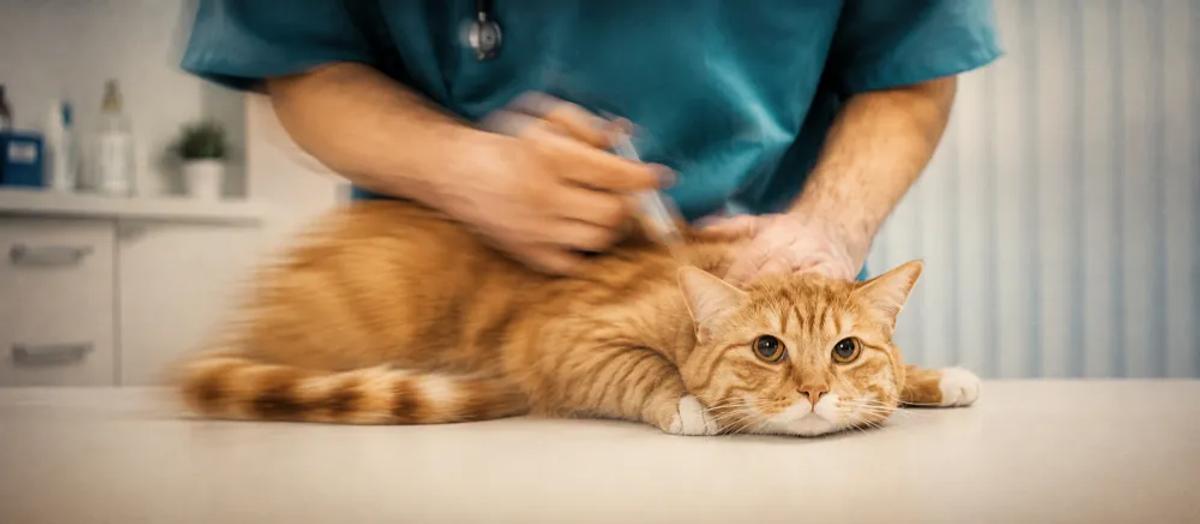
FVRCP is the core vaccine every cat needs, and it is a single shot that covers three viruses: feline viral rhinotracheitis (the herpesvirus), calicivirus and panleukopenia. You will see it written as FVRCP, "3-in-1" or "tricat" on a vaccination card, and sometimes as a "4-in-1" when a fourth component is added. It is the backbone of feline vaccination, and also the shot most often misread on the card.
Those five letters do a lot of work on a vaccination card, so here is what each one means and where the shot sits in the wider cat vaccination guide.
What each letter stands for
Break FVRCP into its parts and it stops being a code:
- FVR, for feline viral rhinotracheitis. This is the disease caused by feline herpesvirus type 1 (FHV-1): sneezing, runny eyes and nose, and a virus that tends to settle in for life and flare up when a cat is stressed or unwell.
- C, for feline calicivirus (FCV). The other main cause of cat flu, known for painful mouth ulcers alongside the runny-nose signs.
- P, for feline panleukopenia (FPV). The serious one, a parvovirus that attacks the gut and immune system and is often fatal in unvaccinated kittens.
So the single FVRCP shot is really cover against cat flu and against a deadly gut virus, rolled into one injection.
How serious are these three
Panleukopenia is the reason FVRCP is not optional. It is a feline parvovirus, and the virus that causes parvo in puppies is a variant of the same species, which turned up in dogs in the mid-1970s. It spreads through infected faeces and contaminated surfaces, and it is notoriously hardy, staying infectious in a contaminated environment for weeks or even months. In an unvaccinated kitten it causes severe diarrhoea and a collapse in white blood cell counts, and fewer than half of cats with the disease survive even with intensive care. In WSAVA's 2014 report on Asian practice, based on fieldwork in 2012 and 2013, 71 per cent of the 144 Indian vets surveyed said they saw feline parvovirus in their practice, which is part of why it sits in the core shot.
Cat flu, the herpesvirus and calicivirus pair, is rarely a killer in an adult cat, though rare highly virulent strains of calicivirus do cause severe whole-body disease that spreads through a group of cats and kills a high proportion of them. Mostly, though, it is miserable and it lingers. Herpesvirus in particular tends to stay in the body for life once a cat has caught it, flaring up during stress, illness or a house move, with sneezing and sore, streaming eyes each time. Calicivirus adds the painful mouth ulcers. In a multi-cat home or a shelter these spread fast, which is how they earn their place in the core shot.
Panleukopenia is not leukaemia
The "P" in FVRCP stands for panleukopenia, a parvovirus that attacks the gut and the immune system. Feline leukaemia is a different virus altogether, FeLV. It has its own separate vaccine in the markets that carry one, given only after a blood test, and India does not appear to be one of those markets. So if a page tells you the "P" covers leukaemia, it is wrong, and a cat whose card shows only FVRCP has had no FeLV cover at all.
The "4-in-1" and other combinations
Vaccine makers bundle components to save injections. When you see a "4-in-1" for cats, it is FVRCP with a fourth component added into the same shot, usually either feline leukaemia virus or Chlamydia felis, which is a bacterium rather than a virus. In India that choice does not appear to arise. All three feline vaccines on CDSCO's published register are the same three-component combination of panleukopenia, calicivirus and rhinotracheitis, so the 3-in-1 is what you are most likely to be offered here.
This is where cards get misread, because the same shot turns up under several names. Check the components printed on the vaccine sticker your vet peels onto the card, not the shorthand written next to it. If the sticker names FPV, FHV-1 and FCV, that is FVRCP whatever the card calls it, and if a fourth name sits alongside them, that is your 4-in-1.
The number in the name is not a quality score. A "4-in-1" is not automatically better than a "3-in-1". It carries one more component, and whether your cat needs that extra comes down to how your cat actually lives. A settled indoor adult may do perfectly well on the core three, which in India is all the published register carries anyway. What matters is which diseases your cat is actually at risk of, and that is a conversation with your vet.
How the FVRCP pieces map to core and non-core
All three FVRCP components are core, meaning every cat should have them. That is the whole point of the combination: it packages the must-have vaccines into one shot. Rabies is core in India too, because the country is endemic for rabies and WSAVA treats the vaccine as essential for cats wherever that is true, and in India it is given as its own separate injection.
FeLV is the awkward one. WSAVA treats the FeLV vaccine as core for cats under a year old and for adult cats with outdoor access, but only in places where FeLV is prevalent, and no FeLV vaccine appears anywhere on India's published register of veterinary vaccines. Testing is the lever you do have, so ask your vet about an FeLV test for the cats already in the home and for any new arrival before you introduce it. Chlamydia and the rest are non-core, added only for specific risks. The core versus non-core guide sorts out which of these your own cat needs.
Frequently asked questions
What is the 3-in-1 vaccine for cats?
It is FVRCP, a single shot covering feline herpesvirus (rhinotracheitis), calicivirus and panleukopenia. These are the three core feline viruses every cat should be protected against, which is why they are bundled together.
What is the 4-in-1 cat vaccine?
FVRCP plus one more component in the same injection, usually feline leukaemia virus or the bacterium Chlamydia felis. Every feline vaccine on India's published register is the same three-component shot, and no FeLV product appears on it at all, so the 3-in-1 is what you are most likely to be offered here. That is a gap in what the register carries, not a sign that the disease is rare: in the same WSAVA 2014 report on Asian practice, 74 per cent of the 144 Indian vets surveyed said they saw feline leukaemia virus in their practice, a higher share than said the same of feline parvovirus.
How many FVRCP doses does a cat need?
Kittens get a series, roughly three to four doses ending at sixteen weeks or older, then a further dose at twenty-six weeks or older rather than waiting for the first birthday. After that, a low-risk cat needs a repeat no more often than every three years by the WSAVA framework, which also allows higher-risk cats to be revaccinated more frequently, up to annually.
Is FVRCP the same as the rabies shot?
No. FVRCP and rabies are two separate core vaccines. FVRCP covers the three feline viruses; rabies is usually its own injection, and always so in India. Both matter for a cat in India.
The bottom line
FVRCP is the one core combination every cat needs, covering herpesvirus, calicivirus and panleukopenia in a single shot. Read the "P" as panleukopenia. Treat a "4-in-1" as FVRCP with an extra your cat may or may not need. For where FVRCP sits among all the cat vaccines, see the main cat vaccination guide, and to work out exactly which shots your cat needs, the core versus non-core guide.
Sources
- 2024 guidelines for the vaccination of dogs and cats. Squires RA, Crawford C, Marcondes M, Whitley N, for the WSAVA Vaccination Guidelines Group. Journal of Small Animal Practice 2024;65:277-316. doi:10.1111/jsap.13718 (FPV, FHV-1 and FCV as the core feline vaccines that make up FVRCP; rabies core wherever rabies is endemic; FeLV core for cats under a year old and for outdoor adults, but only where FeLV is prevalent; the 16-week and 26-week doses, the three-year adult interval, and revaccination more frequently, up to annually, for higher-risk cats).
- Recommendations on vaccination for Asian small animal practitioners. Day MJ, Karkare U, Schultz RD, Squires R, Tsujimoto H, for the WSAVA Vaccination Guidelines Group. Journal of Small Animal Practice 2014. doi:10.1111/jsap.12272 (Table 2, vaccine-preventable feline infectious diseases seen in veterinary practice: of the 144 Indian practitioners surveyed, 71 per cent reported feline parvovirus and 74 per cent reported feline leukaemia virus). Fieldwork was carried out in 2012 and 2013, and the report's statement that no feline vaccines were then licensed in India has since been overtaken by the CDSCO register below.
- Veterinary vaccines granted marketing authorisation. Central Drugs Standard Control Organisation, Ministry of Health and Family Welfare, Government of India (the three feline vaccines on this published register, every one of them the panleukopenia-calicivirus-rhinotracheitis combination; no FeLV product anywhere on the register).
- Guideline for feline panleukopenia. European Advisory Board on Cat Diseases (panleukopenia clinical signs; the virus staying infectious in the environment for weeks or months; fewer than half of affected cats surviving even with intensive care).
- Guideline for feline calicivirus infection. European Advisory Board on Cat Diseases (mouth ulcers and cat flu; highly virulent FCV variants causing severe systemic disease with epizootic spread and high mortality).
- Guideline for feline herpesvirus infection. European Advisory Board on Cat Diseases (lifelong latency after primary infection, and reactivation after stress, lactation or a move to a new home).
- Genus: Protoparvovirus. International Committee on Taxonomy of Viruses (feline panleukopenia virus and canine parvovirus are variants of a single species, Carnivore protoparvovirus 1; CPV arose as a variant in the mid-1970s).
- India launches a national action plan for dog-mediated rabies elimination. World Health Organization (India is endemic for rabies, which is why the rabies vaccine is core for cats here).