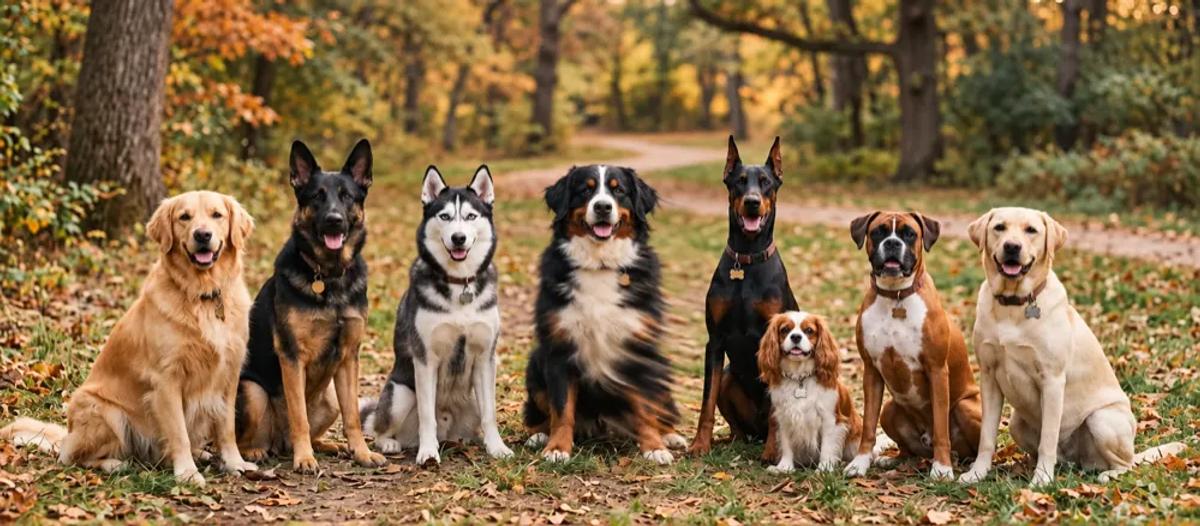
Large dog breeds such as Labrador Retrievers, Golden Retrievers, German Shepherds and Rottweilers need a household that can provide daily care, comfortable handling and activity suited to the individual dog. Compare the work involved before choosing a breed. A feeding bowl, a brush and a route for outings are useful starting points, but each comes with decisions about the dog who will use them.
Size labels vary between breed descriptions. A Labrador may be described as medium-sized in a breed standard. The label alone won't tell you whether a particular dog fits your home. Consider the dog's health and behaviour alongside the time and help your household can offer.
Four large dog breeds to consider
Labrador Retriever
The Labrador is a working retriever with a short, dense coat and a soft undercoat. Its compact-looking coat can make grooming seem like a small part of ownership. There is still skin to check beneath it, and ear handling needs the same patient introduction as brushing.
A study of Labradors in UK veterinary care during 2013 recorded ear disease, overweight or obesity, and degenerative joint disease among common disorders. Those records help identify useful subjects for a veterinary conversation. They do not establish the current frequency of these conditions in Indian Labradors or predict what will happen to a puppy you meet.
If a Labrador is on your shortlist, think about who will measure meals, how treats will fit into the feeding plan and how you will notice changes in movement. The detailed guide to Labrador Retriever care explains those everyday decisions.
Golden Retriever
The Golden Retriever standard describes an active retriever with a dense coat, an undercoat and feathering around parts of the body, including the tail and back of the legs. That gives you something concrete to consider: you will need to become comfortable checking through the coat and learning the grooming your dog needs.
A US Golden Retriever cohort followed weight and orthopaedic outcomes and reported associations with neutering. The observational findings are a reason to discuss the individual dog's care with a vet, including weight management. They cannot settle a neutering decision for every Golden Retriever.
Our Golden Retriever care guide covers coat handling, an individual feeding plan and changes in mobility worth discussing. Compare that routine with the one your household can realistically provide, including during a busy working week.
German Shepherd
The German Shepherd is described as a large working dog with a medium-length double coat. Its breed profile gives a picture of the dog, but a household still needs to assess the individual animal rather than assume that a description of confidence answers every question about behaviour.
UK veterinary records from 2013 identified ear disease, osteoarthritis, digestive problems and weight concerns among commonly recorded German Shepherd conditions. These are historical findings from that population, not an Indian risk ranking. They make everyday observations about comfort, eating and movement useful topics to raise with your vet.
The German Shepherd care guide connects those observations with feeding, handling and reward-based learning. Use it when considering how the dog will live with your family's actual routine, including the people who will take turns providing care.
Rottweiler
The Rottweiler is a muscular working breed with a black-and-rust coat. Its outer coat lies flat, with undercoat described around the neck and thighs. A short-looking coat does not remove the need for skin checks or comfortable handling.
In a UK study using 2013 veterinary records, weight problems, ear disease and degenerative joint disease were among recorded Rottweiler concerns. Those findings support useful care questions; they are not a forecast for an individual dog. A muscular appearance also does not replace a body-condition assessment.
Before choosing one, consider who can carry out the daily routine and how you will get help with handling or behaviour concerns. The Rottweiler care guide develops those questions without treating a breed label as a promise about family suitability.

Check how daily care fits your home
Start with an ordinary day. Who is home when the dog needs an outing, and who will take over when that person is delayed? Where can the dog rest without being disturbed? These are household planning questions you can answer before buying equipment or committing to a particular dog.
Dogs need a comfortable environment with opportunities for movement, toileting and mental stimulation. They also need room to express natural behaviour, such as sniffing and playing. A quiet resting place matters within that arrangement. Discuss the individual dog's needs with a vet when deciding how to provide them.
Consider the route from your front door as well as the room where the bed will go. You might need to plan around a lift, a shared entrance or the person who can accompany the dog outside.
Visitors deserve a plan too. A fearful dog should not be forced to greet someone. Providing an undisturbed retreat is one way to manage a situation while you seek advice about the fear. Ask family members to respect that arrangement rather than each trying a different way to make the dog interact.
Be honest about the help available. If grooming or handling is something you cannot comfortably manage, find appropriate professional support and learn the parts you can do at home. The answer may change as you get to know the dog.
Plan food for growth and body condition
Choose a complete and balanced diet suited to the dog's life stage, activity and health. Your vet can help decide what that means for the animal in front of you. A breed name on a food bag is not enough information to decide whether its nutrient profile fits that dog's needs.
Growth deserves its own conversation. Puppies need a diet appropriate for growth until skeletal maturity, which may occur later in some large and giant breeds. Guidance for these puppies also emphasizes keeping a lean body condition and avoiding excessive calcium intake. Ask when your puppy should move to adult food rather than making the change because another dog of the same breed did.
An adult dog's portions should be adjusted around its individual physical condition. A weight reported in a breed standard, or the average weight in a research sample, describes something different from the ideal weight for your dog. Ask your vet to show you how they assess body condition and what they want you to watch as the dog grows or changes.
Measure the agreed food amount. Treats and table scraps contribute calories too, so bring them into the same discussion. If several people offer rewards, agree how those rewards fit into the day's allowance. Otherwise, a measured breakfast can sit alongside food that nobody has counted.
Weight loss also needs a nutritionally suitable plan. Simply reducing the amount of the usual food can leave an unanswered question about whether the reduced portion still supplies what the dog needs. Discuss the food and the amount with your vet, then review how the dog responds.
Keep fresh, clean water available. Changes in weight or eating are worth discussing, particularly when they occur with reduced energy or another health concern. The feeding plan can be revised as the dog's needs change.
Make room for movement and cooler outings
Physical activity and enrichment belong in the same plan, but they offer different things. A walk can include time to sniff, while a supervised food search at home gives the dog another way to investigate. Choose activities around age, comfort and the dog's response rather than filling a timetable with every exercise associated with the breed.
A dog who stops repeatedly or becomes reluctant to move needs attention to what has changed. Describe the observation to your vet before deciding that the dog needs a harder workout. Stiffness, changes in gait and difficulty rising can be signs of a mobility problem. Planning everyday dog exercise includes making room for those individual needs.
Check the conditions before heading out. Choose cooler conditions, provide shade and opportunities to drink, and avoid strenuous activity in heat or high humidity. A usual departure time does not guarantee a suitable outing. UK research recorded exercise as a trigger for heat-related illness, which supports taking activity into account without estimating the risk of a particular walk in India.
If you are concerned that your dog is overheating, stop and move into a cooler place. Difficulty breathing, weakness or collapse needs immediate veterinary attention; do not wait for several signs to appear together. The guide to walking dogs in hot weather covers preparation and the decisions to make when conditions change.
Prepare for grooming and handling
Make brushing a chance to look through the coat and notice the skin beneath it. Mats, patches of missing fur, injuries or other abnormalities should be discussed with a vet. The care interval and tools need to suit the individual coat. Unnecessary bathing can harm the skin or coat, so a fixed slot on the calendar should not make the decision for you.
Handling can be practised before a task needs completing. Let your dog investigate the brush, then pair a manageable part of the handling with a reward. Keep the session short enough to finish while the dog is comfortable. You can stop early.
Watch for pulling away, freezing, lip licking or other signs of stress in the situation. Pause and make the next practice step smaller. Forcing the dog through the rest of a grooming task can make handling more difficult. If grooming has become stressful, ask your vet or a qualified humane trainer for help.
Reward-focused methods have support beyond grooming advice. A study comparing dogs at different training schools found more stress-related behaviour in the aversive-training group. The dogs were not randomly assigned, and the study did not establish how quickly a particular skill could be taught. Preparing for grooming at home gives more detail on applying gradual, comfortable handling.
Notice changes in comfort and health
The breed studies above suggest questions to keep in mind rather than conditions to diagnose yourself. Watch what your dog does during ordinary care. A change in the way they rise, a new reluctance on a familiar outing or discomfort when an ear is touched gives you a concrete observation to discuss.
Ear redness, odour, discharge or head shaking can occur with different ear problems. They do not identify an infection by themselves. For healthy ears, checking does not automatically mean cleaning; cleaning too often can irritate them. Ask for a plan that fits what the vet finds.
Mobility care is individual too. Weight control and low-impact activity can form part of a veterinary plan for osteoarthritis, but the choice follows assessment. Do not turn another dog's treatment plan into a routine for yours.
Bring concerning changes to the veterinary team instead of saving them for a routine visit. A useful description can be simple: what changed, when you noticed it and what the dog was doing. You don't need to name a disease before asking for advice.
Frequently asked questions
Which breeds are examples of large dogs?
Labrador Retrievers, Golden Retrievers, German Shepherds and Rottweilers are examples commonly considered when looking at larger dogs. Size terms vary between breed descriptions, so this is not a ranking of the world's largest breeds. Compare the physical description with the individual dog's care needs, including comfortable handling, suitable activity and a place to rest.
Choose the next step for your household
Pick the care question that is still unanswered, such as grooming help or a suitable activity plan. Nuzzy's PetMap can help you explore nearby vet and grooming options. Confirm the service you need directly with the provider, including whether they can demonstrate a task you want to learn at home.
Sources
AAHA. Age-specific and breed-specific diets. Nutrition and Weight Management Guidelines, 2021.
Cornell University College of Veterinary Medicine. Osteoarthritis. Updated December 2025.
Aly Cohen. Grooming: cooperative care. Cornell Riney Canine Health Center, February 2026.
Cornell University College of Veterinary Medicine. Fearful dogs.
American Kennel Club. German Shepherd Dog breed profile.
American Kennel Club. Rottweiler breed profile.
AAHA. Changing behaviors. Canine and Feline Behavior Management Guidelines, 2015.
WSAVA. Principles of Wellness. 2025 document.
Cornell University College of Veterinary Medicine. Summer heat safety tips for dogs.
Aly Cohen. Canine enrichment ideas. Cornell Riney Canine Health Center, July 2023.
American Kennel Club. Official standard for the Labrador Retriever. Approved 1994.
American Kennel Club. Official standard for the Golden Retriever. Approved 1981; reformatted 1990.