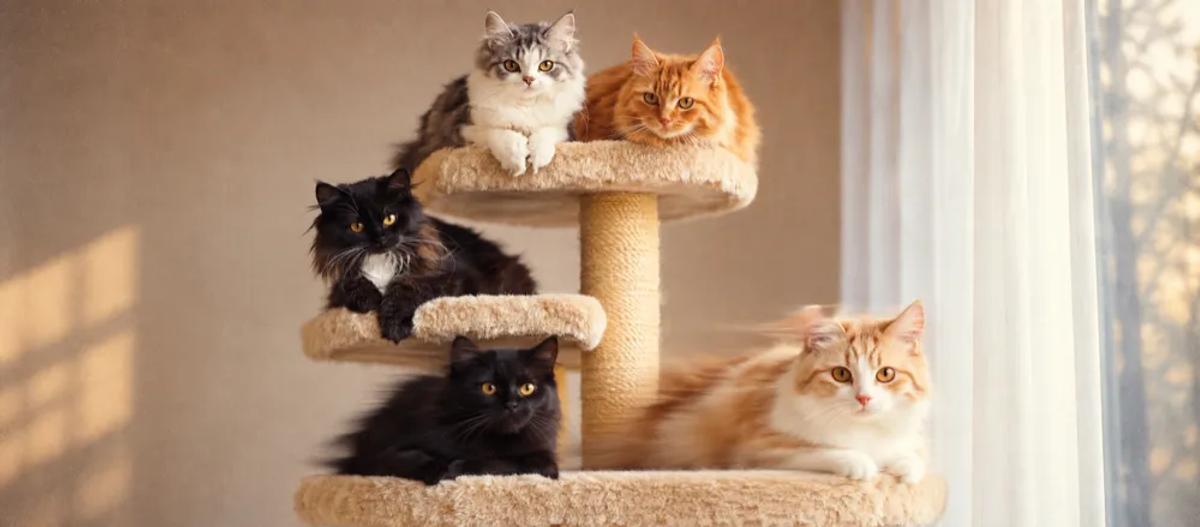
Compare cat breeds by the care you can provide, then get to know the individual cat. Coat type, age, existing pets and the home routine all belong in the decision. A breed description can introduce physical features, but it cannot promise how a particular cat will behave.
This guide compares Persian, Maine Coon, Siamese and Ragdoll cats, alongside the option of a mixed-breed cat. Use it to prepare for a conversation with the current carer and your vet.
Start with the care you can provide
Before choosing a cat, think about its age and personality, the animals already at home, and what its care will involve. An adult cat's established personality can give you a clearer idea of how it may fit into your household. You can ask about the cat's actual routine instead of relying entirely on a description of its breed.
Start with an ordinary working day. Who will offer food, look after the litter box and make time for grooming? If you share those jobs, name the person taking each one.
Then consider the home itself. Cats need thoughtfully distributed resources, including places to rest, food and water stations, scratching posts and litter boxes. They also need places where they can hide. Put these on your preparation list before deciding which coat or colour you prefer.
If another cat already lives with you, plan their introduction. Our guide to introducing cats explains that separate process.
Make two short lists: what you can already manage and what you need to arrange. Put a question mark beside anything unknown. For example, you may have someone willing to brush the cat but still need to learn how to do it.
Compare four cat breeds
The physical descriptions below help distinguish the four profiles. Keep the care questions beside them when making your comparison, so the decision does not end with a photograph.
Persian
The Persian breed description has a stocky body, a long, full coat and a round head with a short nose. The coat is a clear starting point for a care discussion: regular brushing or combing helps keep a cat's coat clean and gives you a chance to observe its skin.
Ask the current carer to describe the grooming routine they actually follow. Find out what you would need to learn and where they currently get help.
The Persian cat care profile covers coat care and the limits of the breed's clinical evidence.
Maine Coon
The Maine Coon is described as a large cat with a coat that is shorter at the shoulders and longer along the sides, stomach and back legs. A long, plumed tail is another feature of the physical profile.
Large size deserves attention in your preparation, but it does not set a feeding target. A veterinary feeding assessment considers the individual cat's age, body and muscle condition, activity and health, among other factors.
Our Maine Coon cat care guide takes the size and coat discussion further and explains the heart-health questions to bring to a vet.
Siamese
The Siamese physical profile has a long, slender body, a fine short coat, a wedge-shaped head and blue, almond-shaped eyes. Colour is concentrated at the points.
If a short coat is what attracts you, keep the rest of the care plan in view. Regular grooming still has a place in general cat care, and the home still needs resting, hiding, feeding and scratching resources. Coat length is only one part of the comparison.
Read the Siamese cat care profile for the physical features and an individual approach to everyday care.
Ragdoll
The Ragdoll is described as a large cat with a broad chest, a long muscular body and a semi-long coat. Its size and coat give you concrete features to compare with the Maine Coon, whose coat has a different distribution.
Handling needs a separate discussion. Respect a cat's signals that it needs a break, whichever breed it belongs to.
The Ragdoll cat care profile covers handling, coat care and carefully limited health findings.
Keep mixed-breed cats in the comparison
Both pedigreed and mixed-breed cats can be excellent companions. If your shortlist began with breed names, leave room to consider a mixed-breed cat using the same questions about age, personality and care.
Ask about the individual cat's history and the routine its current carer knows. For an adult cat, an established personality can help you judge the fit with your household. Describe what you are hoping for honestly, including any pets already at home.
Look at the cat in front of you
Breed descriptions can make personality sound settled in advance. A Finnish owner survey published in 2019 found behavioural variation within breed populations. That supports a restrained conclusion: knowing a breed does not tell you exactly how an individual cat will behave.
Talk to someone who knows the cat. Ask what contact it seeks, what its usual day looks like, and how it responds when people handle it.
During contact, respect signs that the cat needs a break. Ignoring those signals can increase fear. Our guide to reading cat body language gives more detail on considering posture and the surrounding situation.
If family members have different expectations, discuss them before deciding. One person may want a cat they can often hold, while another mostly imagines sharing the room. Put those expectations into words and ask what is known about the cat's preferences.
Notice how cats share the home
If you are meeting a cat that lives with others, ask about their interactions beyond obvious fights. Cats may hiss or swat, but they can also avoid one another quietly. Grooming each other, touching noses and sleeping close together are examples of friendly social contact. These observations give you more to discuss than a broad claim that a particular breed gets along with every other cat. They describe relationships in that home, rather than guaranteeing the same relationship after a move.
Pay attention during human contact too. A tense, flattened posture, freezing, hiding or trying to flee can indicate fear or distress. A cat that stays still is not necessarily enjoying being held. Respect its need for a break instead of extending the interaction to test how much it will tolerate. Ask the current carer how the cat usually seeks contact when it has a choice.
Plan coat care, food and the home
Turn the comparison into a practical care plan. For the coat, regular brushing or combing can help keep it clean and allow you to notice what is happening on the skin. Ask for help with the parts you have not learned. Our guide to grooming a cat covers the practical discussion in more detail.
For food, the veterinary team can consider age, reproductive status, body and muscle condition, activity and health when building an individual feeding plan.
For the home, think about where resources will go. Resting places, feeding and water stations, scratching posts and litter boxes need thoughtful distribution. Include appealing places to hide. Walk through the proposed arrangement with the people who share the home and agree who will prepare each area.
Match equipment to the individual cat
Scratching is normal marking behaviour. Look at both the surface the cat chooses and the direction of the movement. A cat that scratches upright furniture may prefer a vertical post; one that scratches along a carpet may prefer a horizontal option. This is a useful observation to request from the current carer before buying equipment.
Hiding places also need some choice. Some cats retreat upwards when startled, while others seek a low hiding spot. Include those preferences in your room plan instead of assuming that every cat wants the highest perch. A resting area, a hiding place and a scratching surface serve different parts of the care plan, even when a single piece of furniture offers more than one of them.
Check litter-box access as well as where the box will stand. Kittens and elderly cats with arthritis may need lower sides so they can enter easily. That does not mean every older cat has arthritis; use what is known about this cat and discuss mobility concerns with the vet. Keep the box clean, since cats may avoid a dirty litter area.
Plan the food transition
Find out the exact food the cat currently eats before bringing it home. Food should be nutritionally complete and suitable for its life stage. If a change is needed, make it gradually, retaining some of the existing food during the transition. The individual feeding assessment still matters: a breed label cannot supply the portion size, and a large frame does not replace checking body and muscle condition.
Keep food and water dishes away from the litter area, clean the dishes and keep their contents fresh. Mark those locations on the same room plan as the other resources. This makes the preparation more concrete: you can see whether your proposed feeding space is separate from the toilet area before the cat arrives.
Questions to take to the vet
When adopting a cat, ask about its previous vaccinations, nutrition, parasite control and grooming. Arrange a veterinary check as soon as possible after bringing it home. Take the available history with you and identify anything that you have not been able to confirm.
Breed studies can help frame questions, but their populations matter. A Persian study using UK records from 2013 found coat disorders, periodontal disease, overgrown nails and ocular discharge among the most commonly recorded specific disorders. A Ragdoll study published in 2025, using UK records from 2019, reported periodontal disease as its most common disorder.
Those findings do not give the current disease rate for cats in India or tell you what an individual cat has. Use them to ask the vet what this cat's examination and history show. You can also ask which parts of the ongoing care you should learn and which need professional help.
The Ragdoll study examined disorders within that breed without a formal comparison against the other cats in its underlying population. It therefore does not establish that choosing a different breed would avoid those conditions.
Include the mouth in everyday care
Coat care is visible, but oral care deserves its own place in the plan. Ask the veterinary team to examine the mouth and show you how to introduce tooth brushing. Some cats need a gradual introduction. For kittens, veterinary guidance describes using a reward to teach comfortable mouth handling after the initial oral check. Use toothpaste or gel intended for cats, since human products can be toxic to them.
If a cat has gingivitis, consult the vet before brushing; a severely inflamed mouth can make brushing painful. A complete professional dental evaluation also goes beyond cleaning the visible teeth. It includes tooth-by-tooth assessment and dental radiographs under anaesthesia. Ask what an advised procedure involves for your cat. Home care and a full dental assessment are different parts of looking after the mouth.
Questions about comparing cat breeds
How should I compare cat breeds for my home?
Start with the individual cat's age, personality and care needs, then consider existing pets and your household routine. Compare coat care and the home resources you can provide. An adult cat's established personality may help you assess the fit. Keep mixed-breed cats in the comparison too.
What should I consider with a large cat breed?
Treat large size as a physical description, not a target weight. Maine Coons and Ragdolls both have large breed profiles, but a feeding plan should reflect the individual cat's condition, age, activity and health. Prepare the home resources and discuss care with the vet rather than chasing a breed-wide number.
Plan your next care conversation
Use Nuzzy PetMap to look for vet clinics and grooming businesses. Contact the business about the care you need, and take your shortlist of questions to the conversation. Start with the gaps you identified in your plan.
Sources
Cat Fanciers’ Association: Persian physical breed profile.
Cat Fanciers’ Association: Maine Coon Cat physical breed profile.
Cat Fanciers’ Association: Siamese physical breed profile.
Cat Fanciers’ Association: Ragdoll physical breed profile.
Salonen M et al. Breed differences of heritable behaviour traits in cats. Scientific Reports (2019).
Cornell Feline Health Center: Choosing and caring for your new cat.
AAHA/AAFP 2021 Feline Life Stage Guidelines: Behavior and environmental needs.
AAHA/AAFP 2021 Feline Life Stage Guidelines: Nutrition and weight management.