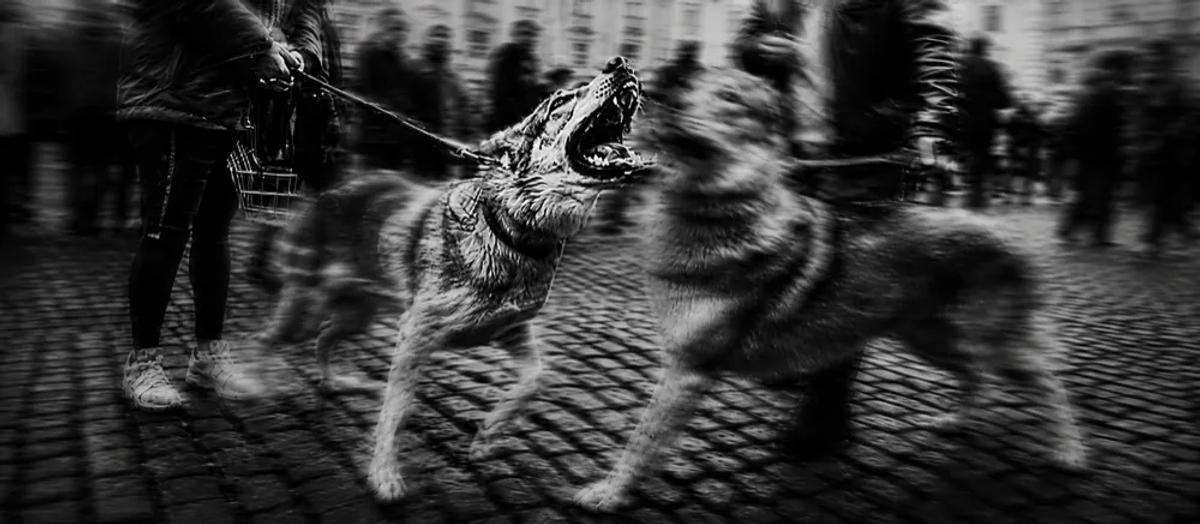
A large Finnish study of 9,270 dogs set out to find what predicts aggressive behaviour towards people. Of everything the researchers measured, fearfulness had the strongest association, and highly fearful dogs had over five times the odds of behaving aggressively compared with dogs that were not fearful.
That finding should change how you read a growl. A dog that growls is often frightened rather than assertive, and treating it as a challenge to your authority points you towards exactly the methods the evidence says carry a welfare cost. Our guide to dog training in India covers why.
What Raises the Risk
The Finnish study, published in Scientific Reports in 2021, drew on an owner questionnaire covering 13,715 dogs. The analysis used a subset of 9,270, comparing 1,791 dogs with frequent aggressive behaviour towards people against 7,479 without it.
Several factors raised the probability: older age, being male, fearfulness, small body size, having no other dog in the household, and being the owner's first dog.
Two of those run against common assumptions and deserve a second look.
Small dogs, not large ones. Small dogs had higher odds of aggressive behaviour than medium-sized or large dogs, and there was no difference between medium and large. The dogs most likely to be growling at your delivery rider are not the ones your society committee worries about.
First-time owners. Dogs belonging to people who had never owned a dog before had higher odds than dogs of experienced owners. Read that as an argument for getting help early in a first dog's life.
The single-dog finding matters here too. Dogs living without other dogs in the household had higher odds than dogs living with them, which is worth knowing in Indian flats where a second dog often isn't practical.
One limit applies to all of it. This was a cross-sectional convenience sample of owner-reported behaviour in Finnish purebred dogs, so the pattern is a population signal rather than a prediction about your dog.
What Breed Predicts
The same study did find breed differences, and the list is not the one you would expect. Rough Collies, Miniature Poodles and Miniature Schnauzers came out with the highest odds. At the other end sat Labradors, Golden Retrievers and Lapponian Herders. The largest single gap ran between Rough Collie and Labrador Retriever, at odds around five and a half times higher. That figure sits close to the fearfulness result quoted above, and the two are not competing: one compares two breeds at the extremes of a twenty-three breed range, the other compares fearful dogs against unfearful ones across the whole sample. Fearfulness is the factor the authors single out, and breed is one variable in the same model.
Look at which breeds those are. None of them appears on any dangerous-breeds list, and two of the three lowest-odds breeds are the ones most often recommended as family dogs in India.
What the researchers concluded from their own data is worth more than the ranking. Their stated conclusion is that improvements in owner education and in breeding practices could alleviate aggressive behaviour towards people. Breed sits in their model alongside age, sex, size, fearfulness, household composition and owner experience, and fearfulness is the factor their data points at hardest.
That is worth saying to a society committee drafting rules about which breeds to permit. It is also worth saying to anyone who assumes a Labrador puppy is a guarantee of anything.
If your puppy is showing fear now, the socialisation work in our guide to training a puppy week by week is the most useful thing you can do about future aggression.
How You Train Changes the Odds
A 2018 study in PLOS ONE took a self-selected sample of 1,564 dog owners, rated each on a scale measuring willingness to use forceful training methods, and set those ratings against a validated questionnaire on their dogs' behaviour. The associations the authors report are, in their own word, modest.
For every one-point rise in an owner's willingness score, the odds of the dog showing aggression towards strangers rose by half again. Owner-directed aggression rose too, on a different scale that the paper reports as a small increase in score rather than a change in odds, so the two are not directly comparable.
The authors are honest about the limits, and so should we be. They write that it is still unclear whether the owner's use of confrontational training is a symptom or a cause of the dog's behaviour problems. A dog that already bites plausibly produces harsher handling in its owner. The association is real, and the arrow is not settled.
What tips the practical decision is the other evidence. A 2020 PLOS ONE study that observed 92 dogs during training sessions found that those trained with a high proportion of aversive methods showed more stress behaviours, higher cortisol afterwards, and more pessimistic judgement in a test conducted away from training entirely. Neither study measured whether corrections teach faster, so we make no claim about that. What is measured is that they raise stress, and in a dog whose problem is already fear, that is a poor trade.
What to Do Instead
Find out what the dog is trying to make stop. Aggression is contextual. Note what is present each time: a stranger at the gate, a hand near the food bowl, another dog on a narrow stairwell, someone reaching for the collar. The pattern is your diagnosis.
Increase the distance. Whatever the trigger is, work at a distance where your dog notices it and stays relaxed enough to eat. That distance is your starting line, and it will be further away than you would like.
Change what the trigger predicts. Trigger appears, then good things happen, then the trigger goes away. Repeated consistently at a workable distance, this changes the emotional response instead of suppressing the display.
Never punish a growl. A growl is information, and it is your dog choosing to warn you before biting. Punish it enough times and you get a dog that skips the warning, which is a substantially more dangerous animal, and you built it.
Manage while you train. Use baby gates and a lead in the house, and stay out of situations your dog cannot yet handle. Every rehearsal makes the aggression stronger.
When to See a Vet First
Before any of the above, rule out pain.
The Finnish researchers note that aggressive behaviour can arise from pain, and that some aggressive dogs may have a disease such as hip dysplasia. They also point out that conditions common in older dogs, cataracts among them, can reduce a dog's ability to perceive someone approaching, which may make it feel insecure and raise the chance of an aggressive response. That is one plausible reason the odds of aggression rose with age in their data.
The AAHA behaviour guidelines make the same point as a procedural rule. Behaviour changes warrant veterinary evaluation to rule out an underlying medical condition.
So the order runs vet first, trainer second. A dog that has become snappy in the last few weeks, or that has started objecting to being touched in one specific place, is describing a symptom. You can find a vet near you on PetMap.
If it is not medical, look for someone qualified in behaviour rather than obedience, and ask two things before you book. Find out how they respond when a dog gets something wrong, and find out what equipment they intend to use. Anyone reaching for a prong or shock collar for a fear-based problem is proposing to add fear to a fear problem.
If your dog's difficulty shows up mainly when you leave the house, that is a different problem, covered in separation anxiety in dogs. For the method principles underneath all of this, and what Indian law says about how a dog may be handled, see dog training in India.
Frequently asked questions
Is my dog aggressive or just protective?
The distinction matters less than what the dog is feeling. Fearfulness had the strongest association with aggressive behaviour of anything measured in the Finnish data, so treating it as fear will usually have you working on the right thing.
Can an aggressive dog be trained?
Behaviour can change, though the goal is improvement rather than a cure. You are aiming for a dog that copes with a trigger at a manageable distance, not one that stops noticing it. Get a medical cause excluded first.
Why is my small dog more reactive than the big dogs I know?
That pattern shows up in the data. Small dogs had higher odds of aggressive behaviour than medium or large dogs in a study of over 9,000 animals, and there was no difference between medium and large.
My dog growls at me over food. What do I do?
Stop taking the bowl away, feed somewhere the dog is not crowded, and get help from someone whose approach starts with the fear. Do not punish the growl.
Sources
- Mikkola S, Salonen M, Puurunen J, Hakanen E, Sulkama S, Araujo C, Lohi H (2021). Aggressive behaviour is affected by demographic, environmental and behavioural factors in purebred dogs. Scientific Reports 11, 9433
- Dodman NH, Brown DC, Serpell JA (2018). Associations between owner personality and psychological status and the prevalence of canine behavior problems. PLOS ONE 13(2): e0192846
- Vieira de Castro AC, Fuchs D, Morello GM, Pastur S, de Sousa L, Olsson IAS (2020). Does training method matter? Evidence for the negative impact of aversive-based methods on companion dog welfare. PLOS ONE 15(12): e0225023
- 2015 AAHA Canine and Feline Behavior Management Guidelines, American Animal Hospital Association. J Am Anim Hosp Assoc 2015; 51:205 to 221