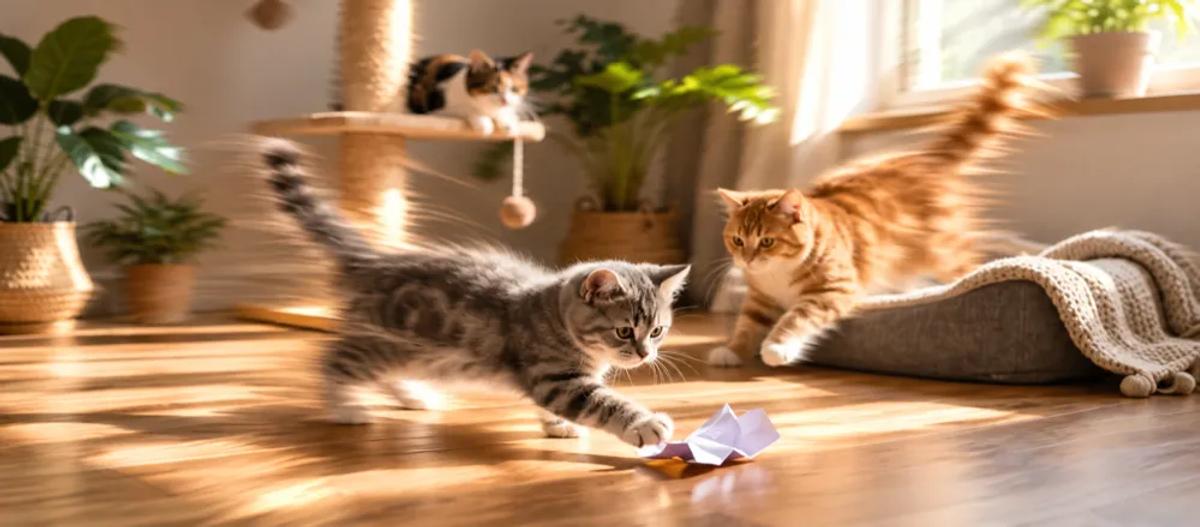
Cat behaviour makes more sense when you look at the whole situation and compare it with your cat’s usual habits. A cat resting under a chair, avoiding another cat in the hallway or no longer jumping onto a favourite seat is giving you something specific to observe. Changes in behaviour deserve a veterinary assessment because medical problems and social tension can overlap.
Start with what you can see. Notice where your cat goes, what happens nearby and whether the pattern repeats. A single encounter gives you only part of the picture; watching daily life helps you describe the concern without guessing at its cause.
Watch your cat’s everyday patterns
Pay attention to the ordinary parts of your cat’s day. Notice the route to the food bowl and the places your cat chooses to rest. In a home with more than one cat, watch what each does when the other enters the room. Walking away, hiding or being blocked from a doorway can be relevant even when you have never seen a fight.
For a practical home check, follow one familiar route with your eyes: from the resting place to the food area, for example. Look for places where another cat stands or stares. Describe the sequence you see, including whether your cat carries on, waits or leaves. These are observations you can discuss with your vet; they do not establish a diagnosis.
A change matters even when it looks quiet. A cat that has stopped jumping onto its usual seat needs the change assessed. So does a cat whose hiding or daily routine has changed. You do not have to decide whether pain or a relationship problem explains it before asking for help.
Keep your description close to the event. “She went back to the bedroom when the other cat stood in the doorway” gives a clearer account than assigning an emotion you cannot confirm. Add whether you have seen the same interaction on other occasions. If several family members care for the cat, compare what each has noticed so the vet receives the full picture.
Let your cat choose contact
Let your cat approach you and choose whether to make contact. Lower yourself to the cat’s level, avoid a fixed stare and give it time to sniff your hand. When the cat appears relaxed and wants to interact, gentle strokes around the head and cheeks are an appropriate place to begin. Individual preferences still matter.
When your cat moves away, let the interaction end. Don’t follow it with another attempt to pick it up or continue stroking. One cat may enjoy sitting on a lap while another prefers a brief greeting. Learn the preferences of the cat in front of you, including the kind of contact it accepts and when it chooses to leave.
Soft muscles and a relaxed posture help you interpret the moment. Ears pointing forward can occur in a relaxed cat, but ear position belongs in a wider reading of the body and surroundings. Our guide to reading cat body language explains how to put those observations together.
Use rewards when you are teaching a behaviour, and avoid verbal or physical punishment. Spraying water or throwing something at a cat can increase fear and damage your relationship. The home-care response begins with allowing choice and meeting the cat’s needs, including giving it room to end an interaction.
Create places to rest and play
A cat needs a private, secure place to retreat. A resting spot with a sense of enclosure can give it somewhere to be out of view. Raised places can also serve this purpose when they are suitable for the individual cat. Look at the shelter the spot provides, including what the cat can see from inside it.
When cats share a home, think about the way into and out of a hiding place. Options with two separate routes can prevent another cat from blocking the only exit. A resting place is less useful if reaching it means passing a cat that repeatedly blocks the way. Watch how each cat uses the options you provide.
You can assess the arrangement in a flat by looking at access and separation. Resting places and other resources should be available in different locations, with choices that each cat can reach. The floor plan needs to account for the cats who live there. A place that is convenient for the family may need adjusting if one cat cannot use it comfortably.
Play deserves its own place in the routine. Use suitable toys that a cat can chase, pounce on or manipulate, and allow the cat to catch the toy during interactive play. Rotate the toys you offer. Some toys work well for batting around, while a larger soft toy gives a cat something to bite and rake.
Keep your hands and feet out of play. Supervise toys with string or parts that could be swallowed, then put those toys away when the session ends. A wand toy left on the floor after play is still an object the cat can reach; storing it is part of finishing the activity.
Make play available to each cat in the household. Shared living does not remove the need for enjoyable play opportunities. Observe which objects each cat chooses and use that information when you arrange the next session.
Keep food and litter areas accessible
Food, water and litter need separate locations. Resting and scratching areas also belong in the wider arrangement of the home. Avoid putting every resource together simply because one corner is easy to clean. The practical task is to give each cat access to what it needs without crowding all those activities into the same place.
Cats should have separate feeding opportunities, including cats that get along. Depending on the home and the cats, that can mean separate rooms or a visual barrier between eating places. A simple barrier can interrupt the view between cats when physical separation is not workable. Watch whether the arrangement lets each cat eat without competing with the other.
When deciding where to put the bowls, review the route to them as well as the location itself. The same principle applies to the litter area. If another cat blocks the approach, the bowl or box may be present without being freely accessible. Several options in different places give the cats more choice.
For questions about what goes in the bowl, see the guide to choosing your cat’s food. If a kitten is joining the family, helping a kitten use the litter box covers the setup and learning task in more detail. Keep those individual care decisions alongside the practical question of where the cat can reach its supplies.
Review the arrangement from each cat’s point of view when the household changes. Follow the routes again and watch the spaces between resources. A shared home needs usable choices for the cats already living there as well as for a newcomer.
Understand scratching at home
Scratching is normal cat behaviour. It is also one way cats leave scent marks. A scratched chair is frustrating to find, but the behaviour needs an appropriate outlet in the home. Providing a place to scratch is part of caring for a cat’s everyday needs.
Look at the scratching options as you would the feeding or resting areas: they need to be available and accessible. In a home with several cats, one shared location may not give each cat an easy choice. Include scratching areas when you review how the home is arranged, rather than treating them as an afterthought.
The aim is to make room for normal scratching in a way the household can manage. Our guide to cats scratching furniture looks at materials and placement, and explains what to review when the pattern changes.
A change in scratching should also be considered alongside the wider routine. Notice what else is happening and discuss a change in behaviour with your vet. Scratching alone cannot tell you why the pattern has shifted.

Sharing a home with other cats
Cats differ in their social needs. Another cat is not automatically the right addition to the household. Consider the resident cat and the space and resources available before deciding to bring a newcomer home. Some cats form close relationships, while other pairings involve distress or difficulty sharing the environment.
Mutual grooming, rubbing against each other and sleeping in physical contact can help you recognise a close relationship. Notice whether the cats choose those interactions. Simply finding both cats near the food bowls gives you less information, especially if that is the only place the food is available.
Watch the less obvious interactions too. One cat may move away when the other approaches or use a resting place at a different time. Cats sharing a room can still be managing distance from one another. A lack of open fighting does not answer every question about how comfortably they share their home.
Before adding another cat, consider whether you can meet the needs of both. That includes the resident cat’s access to familiar resources and the newcomer’s own places to rest and eat. The decision deserves thought even when the family is keen to provide companionship.
If you are preparing for a newcomer, use the guide to introducing cats gradually. It explains the separate starting space and how to work through introductions while watching both cats’ responses. Keep that preparation ahead of the first meeting so that the household has a plan for the arrival.
When to ask your vet
Arrange a veterinary assessment when your cat’s behaviour changes. New hiding, reduced jumping or a changed pattern of daily activity can reflect a medical problem, social tension or an overlap between them. The explanation may need an examination and a discussion of what happens at home.
Tell the vet what your cat usually does and what has changed. Include the places or activities involved. If your cat used to jump onto a particular seat and now stays on the floor, describe that difference. Avoid deciding that the cat is simply getting older or has chosen a new personality before the change has been assessed.
Follow your vet’s advice for your cat, including any further assessment they recommend. Discuss practical changes to the home alongside medical care when both are relevant.
Questions about cat behaviour
Which changes in cat behaviour should I discuss with a vet?
Discuss any change in your cat’s usual behaviour, including new hiding, reduced jumping or a different daily routine. Medical problems and social tension can both be involved, so the change needs veterinary assessment. Describe what you have observed and how it differs from the cat’s usual habits.
Keep the care history together
Keep your cat’s vet-visit history in Nuzzy PetLife for the next care discussion. Having previous visits together gives the family a place to refer back to when preparing for an appointment.
Sources
- AAFP task force. 2024 AAFP intercat tension guidelines: recognition, prevention and management. Journal of Feline Medicine and Surgery (2024).
- Ellis SLH et al. AAFP and ISFM Feline Environmental Needs Guidelines. Journal of Feline Medicine and Surgery (2013).
- Quimby J et al. 2021 AAHA/AAFP Feline Life Stage Guidelines. AAHA guideline publication (2021).